
Cleopatra, Stripped of Myth
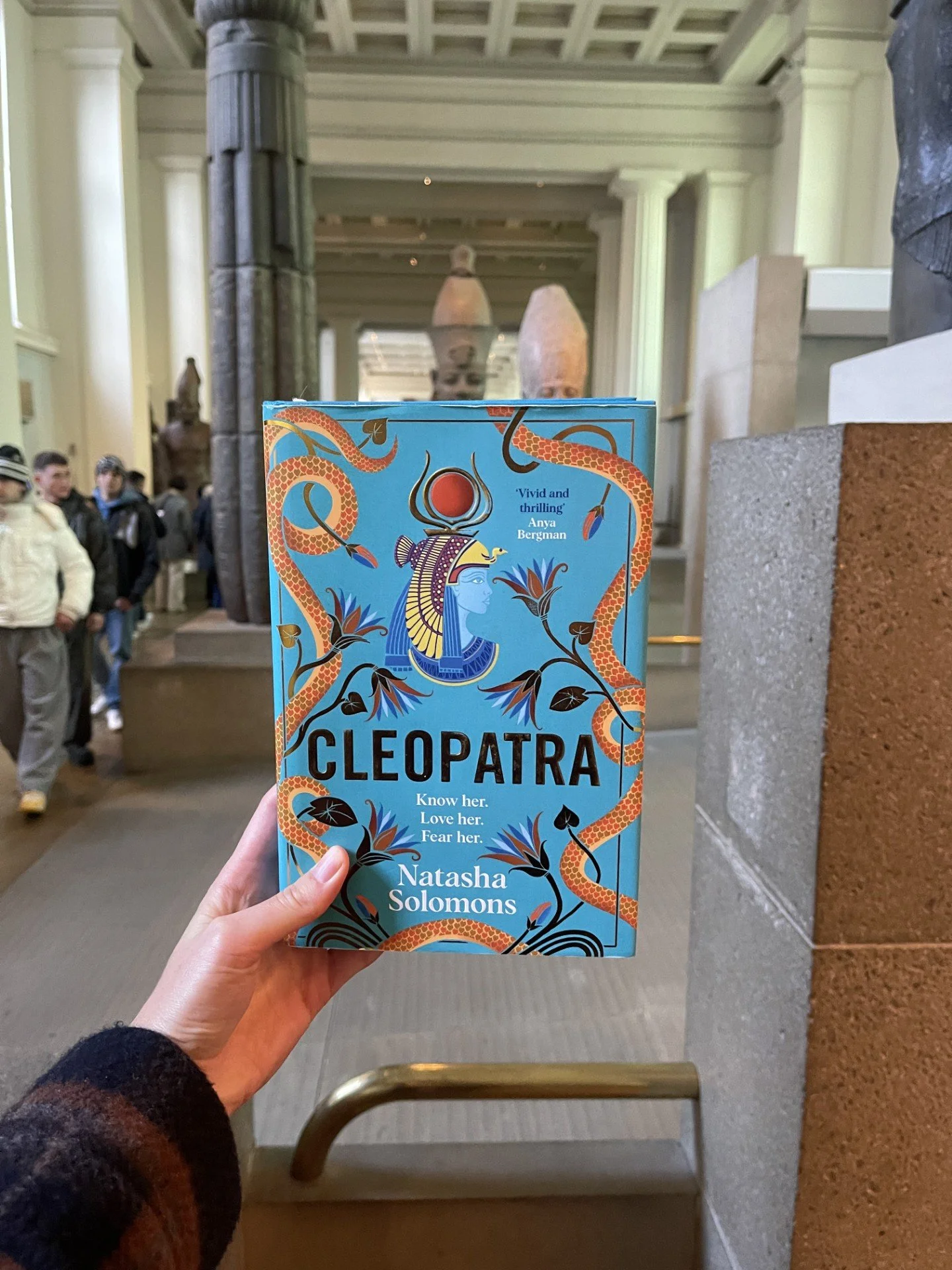
Cleopatra by Natasha Solomons - pictured in the British Museum (a great accompaniment to the book).
Some books are incredibly easy to review, and this was one of them. Cleopatra by Natasha Solomons was an instant delight. Teeming with rich imagery and immersive detail, the novel transported me to an ancient Egyptian world I had never before fathomed - and at its center, the formidable, otherworldly queen herself: Cleopatra.
Solomons does something truly remarkable in Cleopatra: she takes one of history’s most recognizable figures and reimagines her in a way that feels vivid, grounded, and deeply authentic. For centuries, accounts of Cleopatra have been written almost exclusively from Greek and Roman perspectives, leaving both the narrative and her legacy in the hands of her enemies rather than her allies. In hindsight, it’s clear how absent Cleopatra’s own voice is from the historical archive, and Solomons’ novel is an ambitious and compelling attempt to give it back.
Through Solomons’ lens, we follow Cleopatra’s life from childhood to the aftermath of Julius Caesar’s murder. After her father’s death, a bloodthirsty scramble for the Egyptian throne erupts, forcing Cleopatra to go up against her brother, Ptolemy, to secure both her freedom and her power. In order to survive, she must rely on the support of her supposed ally, Julius Caesar. Their relationship is rendered with remarkable subtlety, capturing the delicate political and personal balance Cleopatra would have been forced to maintain. Her cunning, resilience, and diplomatic skill are never in doubt, and Solomons ensures we never underestimate them.
In her own time, Cleopatra was believed to be a living goddess, and the novel hums with an otherworldly quality that I absolutely adored - the ancient rituals, prayers, and sacrifices; the superstitions, beliefs, and seemingly absurd luxuries of the era. The world-building is lush and immersive, speaking to the incredible depth of research behind the novel. Scattered throughout are fascinating historical details: did you know Cleopatra’s palace now lies beneath the Mediterranean Sea? I certainly didn’t. Or that Cleopatra was in Rome when Julius Caesar was murdered? Again, news to me.
By the time the novel ended, I felt as though I had met the most authentic version of Cleopatra yet. Skimming through other reviews, I noticed many highlighted the sections dealing with Cleopatra’s personal life as particular standouts - and I couldn’t agree more. From her daily life in the Egyptian palace to travelling through Rome on her litter, from her royal court to her complex relationships with her sisters, her slaves, her advisors, and her enemies, these intimate details bring her fully to life. For all the grit, grandeur, and political drama, it is Cleopatra herself - and the minutiae of her world - that truly made the novel sing.
So there you have it. One of history’s most misunderstood women is, at last, reintroduced - not as a myth or a seductress, but as a woman of intelligence, depth, and humanity. Even if you’re not a history buff, or have little interest in ancient Egypt, this novel reads with the momentum and immersion of great fiction.

This review was written by our Lead Reviewer, Jess Pagel. When Jess isn’t dreaming of Ancient Egyptian palaces, you can find her reviewing books at @fiftytwo_books.
If you’d like to become a book club review writer, or if you are a publisher and would like to contact us, please email: tfbcbookreviews@gmail.com